

General Program
ROCKFORD UNIVERSITY
6TH ANNUAL HUMANITIES CONFERENCE

April 17th – April 18th 2026
Location: Fisher Memorial Chapel
Rockford University 5050 E State St. Rockford, IL 61108
All times are Central Standard Time
| Official Conference Playlist |


__________________________________________________________
Friday, April 17, 2026
4:00 to 5:15 pm – Emerging Scholars Lab
Moderator: Dr. Genevive Dibley, Rockford University, Classics and Religion
The Emerging Scholars Lab is sponsored by the Journal Intersections: Early Jewish and Christian Trajectories is a peer-reviewed academic open access journal funded by Hebrew University (Jerusalem), the University of Oslo (Oslo), and DePaul University (Chicago). The Intersections Emerging Scholars Lab is designed to critically engage the work of undergraduate scholars interested in graduate-level academic study. Students’ papers refined in the Lab will be published in the Emerging Scholars section of the journal.
Student Participants:
Divine Cannibalism: Drink, Swallow, Become Anew
Masha (Maria) Holubeva, Rockford University
English major/Religious Studies and Secondary Education minors, Senior
Abstract: Blood has been a vital culinary ingredient present in various cultures throughout history. From Elamite broth to black pudding in the United Kingdom, blood-based dishes have spanned peoples, regions, and continents. Yet alongside its widespread culinary use, it had been marked as prohibited within the biblical dietary law. To consume blood would be to consume life itself, thus those who partook in it were to be cut away from the people. This paper examines how early Jesus followers balanced the thin line, in which they transformed blood from forbidden into salvation. Paying attention to Roman dishes stemming from the legendary cookbook Apicius, and the anxiety surrounding cannibalism, the Eucharist is placed alongside ancient culinary practices. Showing that early Jesus followers did not negate the law, but instead repurposed drinking the metaphorical blood of Christ as a means of transformation.
The Army of God and the Phallus: An Inquiry
Annelise Loser, Rockford University
History major/Religious Studies minor, Fall 25 Rockford University graduate
Abstract: This project analyzes gender, domination, ritual, and perfection in narratives dealing with angels in the Hebrew Bible, Pseudepigrapha, New Testament, and Rabbinic literature. Genesis 6:1-4 and I Enoch 6-11 describes a scene in which a group of semi-divine beings (angels/Watchers) descend from heaven and reproduce with human women in an act of unholy mixing. In 1 Enoch 15:7 God commands Enoch to tell the Watchers that he had not given women to the Watchers because they were immortal and had no need of children. This raises the question; why would angels have male reproductive organs capable of reproduction at all? From the antiquity the phallus and power have been inexorably linked. This paper speculates that to be the powerful divine army required the potent symbol of power itself – the generative male organ. Psychologists have coined the term ‘situational homosexuality’ to describe sexuality when there is only the same sex available such as within armies of all males. This practice has been known to exist across cultures and history.
Respondents:
Dr. Troy Martin
Professor of Biblical Studies in the Department of Philosophy, Religious Studies, and Theology at Saint Xavier University
Dr. Fabio Caruso
PhD University of Florence, Italy, in Roman History/Political and Cultural History of Classical Antiquity, and PhD Candidate Loyola, Chicago in New Testament and Early Christianity
Break for Dinner – on your own
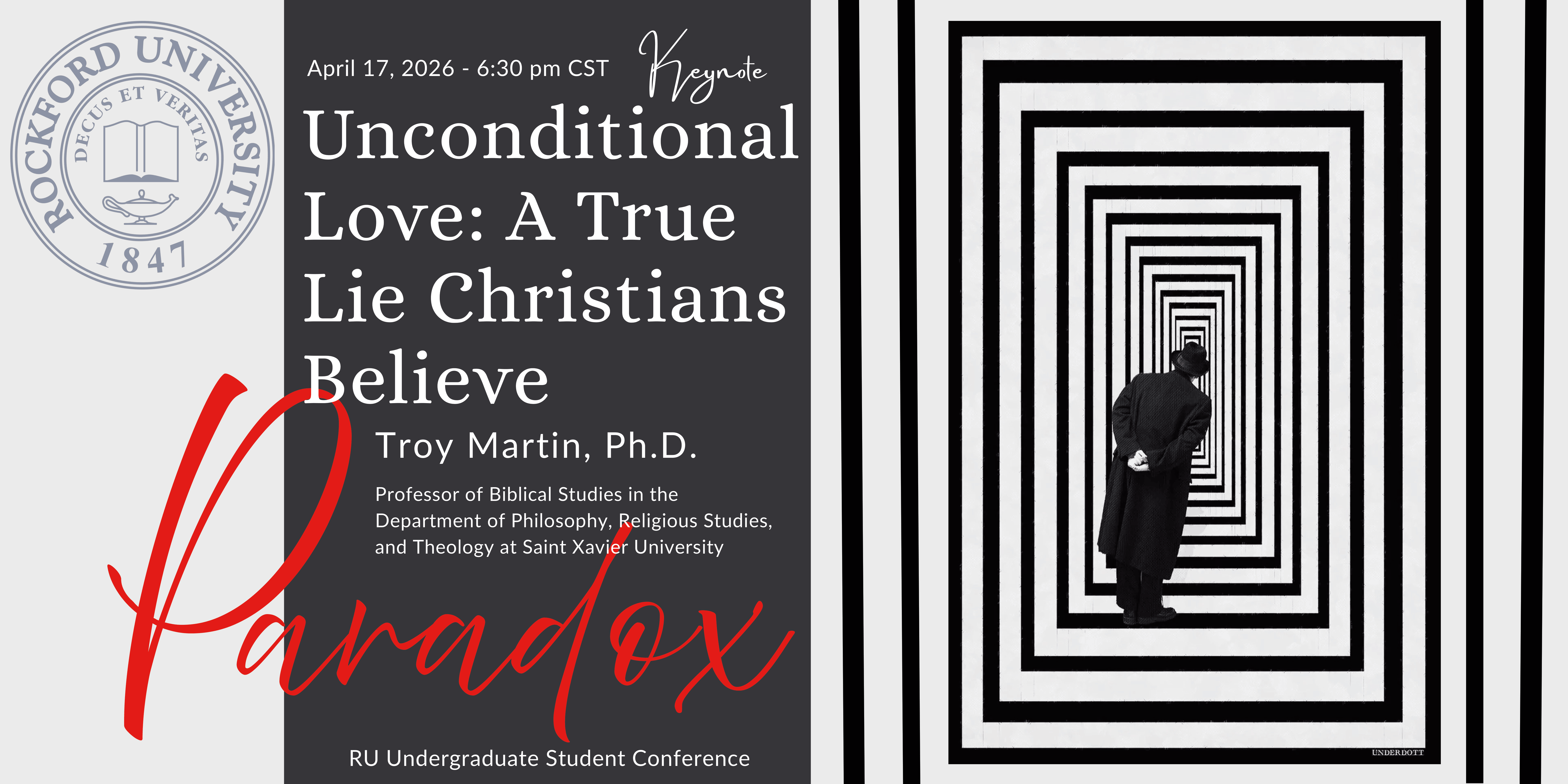
7:00 – 8:30 pm Keynote Speaker Presentation
Moderator: Dr. Genevive Dibley, Rockford University, Classics and Religion
Unconditional Love: A True Lie Christians Falsely Believe
Dr. Troy Martin
Professor of Biblical Studies in the Department of Philosophy, Religious Studies, and Theology at Saint Xavier University
Discussion to follow
Saturday, April 18, 2026
9:30 – 9:45 am – Opening Remarks
Rodolfo (Rudy) Vazquez
Currently studying a Master of Arts in Theology, Concentration in Biblical Languages and Literature at Loyola University, Chicago (class of 2027) and a Master of Business Administration with a concentration in Finance at Rockford University (class of 2026). Rockford University Alumni (class of 2024) graduating with Criminal Justice, Psychology, and History majors/Religious Studies and Ancient and Medieval Studies minors
9:45 to 10:45 am – Paradoxes of Medea in Cuban Theater: A Bilingual Play Published by Rockford University (Book Presentation and Dramatic Reading)
Moderator – Dr. Yoandy Cabrera, Rockford University, Classics and Religion, and Spanish
Dr. Yoandy Cabrera – editor of the volume, RU
Angela Pérez Domínguez – translator and RU alumna
Dr. Stephanie Quinn – presenter, RU
Andrew Johnson – proofreader and RU student
Solomon Keip – proofreader and RU student
Dr. Jennifer Rea – final proofreader of the English text, RU
10:50-11:50 am – Between the Cracks: Resilience, Representation, and Justice
Moderator – Dr. Elizabeth Twitty, Rockford University, Criminal Justice
Trump’s Women
Fallon Perry, Rockford University
The Wrongfully Convicted
Ashley Harkey, Rockford University
Jokes on Us: Black Digital Humor and the Work of Resilience
Kennedy Bryant, Rockford University
15 minutes discussion
LUNCH – RU Cafeteria
1:00 to 2:00 pm – Orthodoxy and Orthopraxy: Paradoxes in Belief and Practice
Moderator – Dr. Genevive Dibley, Rockford University, Classics and Religion
Corpses to Heal, Corpses to Steal: Reliquaries and Resurrectionists
Zoie Howard, Rockford University
Lot Left Behind: Rethinking Righteousness, Intercession, and Moral Ambiguity in Genesis 18 and 19
Eric Whittaker, Rockford University
Baby Jesus Gas Thief
Andrew Johnson, Rockford University
15 minutes discussion
2:10 – 3:25 pm – Paradox Through Time: Case Studies from the Individual, Social, and Universal
Moderator – Dr. Scott Harris, Knox College, Religion
Masculine Women and Feminine Man: Early Christian Gender Expression
Danny Schiffer, Knox College
Asceticism and Anorexia: How Religion and Anorexia Nervosa Have Historically Intertwined
Lyn Kress, Knox College
The Patent Problem: Classical Liberalism and Constitutional Contradiction
Bryce Woodard, Knox College
The Moral Code of the Omniscient
Isabella Maldonado, Knox College
15 minutes discussion
3:30 – 4:30 pm – Playing Ourselves as Other: Examining the Paradoxical Relationship between Player, Character, and Self within Contemporary Narrative-based Video Games
Moderator – Dr. Michael Perry, Rockford University, English
Clementine and her Journey to Humanity: Exploring Paradoxes Between the Character and the Player in Choice Based Video Games
Kylie Gehl, Rockford University
Paradox Within Punishment: The Suffocating Guilt of James Sunderland in Silent Hill 2
Brooklyn Harnesk, Rockford University
Sul Sul to the Player: Exploring the Avatar and Player in The Sims through a Literary Theorist Lens
Jay Pierce, Rockford University
15 minutes discussion
CLOSING REMARKS
Dr. Matthew Flamm – Rockford University, Philosophy
Paper and Artist Awards
2027 Conference Theme and Date Announcement
___________________________________________________
Abstracts
Kennedy Bryant Rockford University
Criminal Justice major, Sophomore
Jokes on Us: Black Digital Humor and the Work of Resilience
Black collective identity is formed, in part, through generational suffering. Yet, with such an enduring history of racialized oppression exists a parallel tradition of resilience, sustained through storytelling, art, and most significantly, humor. This paper explores the central paradox of Black digital humor as both a contemporary tool and a perpetuation of generational trauma. In this sense, Black digital humor exists as both a symptom of racialized trauma and a means of its transformation. Focusing on humor and prosocial practices across various online platforms, literature examines how virtual participation in meme-based communities strengthens the resolve and connectedness of Black individuals. Drawing on interdisciplinary research in psychology, sociology, and neuroscience, this paper situates humor within both biological and sociocultural frameworks, arguing that it is a form of emotional labor and cultural knowledge production.
__________
Dr. Yoandy Cabrera (editor of the volume, RU) with:
Angela Pérez Domínguez (translator and RU alumna)
Dr. Stephanie Quinn (presenter, RU)
Andrew Johnson (proofreader and RU student)
Solomon Keip (proofreader and RU student)
Dr. Jennifer Rea (final proofreader of the English text, RU)
The panel will feature a presentation and dramatic reading of the bilingual (Spanish–English) edition of Medea Prefabricated, a play by Cuban playwright Iran Capote and the most recent publication of the Department of Languages, Philosophy, Religion, and Cultures at RU. Dr. Stephanie Quinn will introduce the volume, followed by a roundtable conversation with the editors, translator, and student collaborators about the publication process.
Medea Prefabricated reimagines Euripides’ Medea within a Caribbean context. In this adaptation, Medea embraces her identity as a woman with unapologetic intensity, rejecting notions of modesty and restraint. Her ferocity and rage emerge directly from her femininity, while both her ideas and her capacity for love are inseparable from a deeply physical, impulsive, and primal sense of self.
This bilingual edition features a translation by Angela Pérez Domínguez, who earned her B.A. in Spanish from Rockford University in Spring 2023. Her undergraduate thesis included both the translation and a critical analysis of the play. The revision process was completed in Fall 2025 as part of SPAN 379: Publishing in Spanish, taught by Dr. Yoandy Cabrera. Students Leonel Bautista, Gabriel Carreño, Andrew Johnson, and Solomon Keip contributed to the final editing. As in previous departmental collaborations with kýrne, Dr. Jennifer Rea oversaw the final editing of the English text
__________
Kylie Gehl, Rockford University
English major, Junior
Clementine and her Journey to Humanity: Exploring Paradoxes Between the Character and the Player in Choice Based Video Games
This game series adapts to the choices you make. The story is tailored by how you play. The opening line to Telltale’s The Walking Dead video game serves as a warning to players that the choices they make throughout their gameplay affect the characters and the decisions they make. Focusing on multiple key points across several episodes throughout the four seasons, most importantly being episode 5 of season 1; “No Time Left” and notably the finale of the last season; “Take Us Back”, this paper explores how the decisions made by players cause changes to the protagonists and the transition from playing as Lee, the parental figure who takes on the task of Clementine’s survival, to Clementine, who becomes that figure to a young boy named AJ. This paper explores paradoxical differences between playing as the character versus becoming the character, and how those decisions reflect onto other characters that you will eventually become yourself, creating a potentially infinite chain of events throughout the timeline of the 23 episodes available to the player. This paper also takes a psychoanalytical approach to our character Clementine; how being raised during an apocalypse can force one to let go of one’s childhood at a young age and come to terms with becoming an adult as a young girl in order to survive. However, due to one’s choices in game creating a curated story, another paradox is created, as it is on
__________
Ashley Harkey, Rockford University
Criminal Justice and Psychology majors/Forensics minor, Junior
The Wrongfully Convicted
America: The Land of the Free, Home of the Brave. That is what we are taught growing up when learning about the United States alongside the countless documents we have to claim that every person has an equal chance to live with freedom here in this country. If this is the case, then how is it that we have innocent individuals losing parts of their life due to being incarcerated for reasons they were falsely accused of? When looking at history, there are many stories of Americans who were placed into prisons for failed forensics, false eyewitness reports, and more, and even though we as a society can acknowledge this is happening, it is even harder for them to become free than to be locked away. For this research, I have taken initiative in clarifying the main six reasons for why individuals are wrongfully incarcerated, the mental and physical tolls it causes for the human beings who had to deal with this catastrophe in the past 35 years, and steps we as Americans can take to fix this paradox.
__________
Brooklyn Harnesk, Rockford University
English major/Criminal Justice minor, Senior
Paradox Within Punishment: The Suffocating Guilt of James Sunderland in Silent Hill 2
This paper is centered around an analysis of the Silent Hill 2 Remake released in 2024. By using an underpinning of both American New Criticism and Russian Formalism, this paper focuses on ideas that address the concept of universal truths and how the explanations behind them vary heavily while also being something consistent. While mainly focused on the game’s main character, James Sunderland, this analysis will also examine the inclusion of other characters and their own struggles and motivations, thus showing off various perspectives that are flawed. By the game’s end, the player is asked to question why exactly they want James to survive after the reveal that he has killed his wife, Mary, who was suffering from an incurable disease. Whether his motive behind killing her was to end her suffering, removing her from his life and moving on, or even a combination of both isn’t concrete. Instead, it is something that is explored and decided by the player through their actions and one of the many endings that they receive. At the same time, a paradox exists in both the character of James and the player, as the game does not give a definite answer as to what is the “true” ending and what his feelings are exactly. The existence of the paradoxical endings and interpretations play into the artistic choices and deep meanings within this psychological horror game that explores the harsh truths and contradictions within human psyche and nature.
__________
Zoie Howard, Rockford University
Political Science major/Religious Studies minor, Senior
Corpses to Heal, Corpses to Steal: Reliquaries and Resurrectionists
In 18th century England, a shortage of legally sourced cadavers for medical schools created a group of “resurrectionists,” who stole fresh bodies to use in anatomy schools. This practice, while technically not illegal, was shocking to the public, and considered desecration of a corpse by the church. The Catholic Church, however, at this time and previous, utilized first-class relics, the remains of saints, as part of their practice. This paper will explore the paradox between the use of corpses, both for healing purposes, yet one is deemed sinful and the other sacred. Where is the line drawn, and what makes some corpses holier than others?
__________
Andrew Johnson, Rockford University
Spanish major/History minor, Senior
Baby Jesus Gas Thief
El Niño Huachicolero is paradoxical in his presentation using that of the standard Baby Jesus image for organized crime, fuel theft in Mexico. Whilst the image of the Baby Jesus is rooted firmly in Spanish Catholicism and the evangelization of the New World, this iteration of the Christ Child, borrowing from the Atocha image in Spain, is unprecedentedly plasticized in his presentation as a gas thief. Devotionals to this Niño Dios vary from dolls adorned with a gas can and siphon to more elaborate ofrendas (altars) that brandish oil drums to earn favor and protection in a highly volatile industry of life and death.
__________
Lyn Kress, Knox College
Creative Writing and Studio Art majors, Sophomore
Asceticism and Anorexia: How Religion and Anorexia Nervosa Have Historically Intertwined
“Holy Anorexia”, a term coined by Rudolph M. Bell in 1987, is the theory that popularized extreme cases of asceticism are more alike to modern day anorexia nervosa than it had been portrayed as previously. Discussing both medieval cases, like Catherine of Siena and Margery Kempe, and more contemporary cases of asceticism and anorexia nervosa will shed light on Bell’s argument through a more modern lens of our understanding of anorexia nervosa today.
__________
Isabella Maldonado, Knox College
Undeclared, Freshman
The Moral Code of the Omniscient
This paper considers the age-old question, ‘Does the God of the Bible care more about being good, or being fair?’ Thinking about the morality of God from this seeming contradiction prompts a deep dive into what the Bible itself says about this topic. My presentation will discuss the nuances of this question, and hints at a deeper question: one involving the relevance of the morals of an ancient God, versus the morals of a Gen Z US citizen in the 21st century. Is there any overlap? Should there be? I will be examining passages throughout scripture, but anchoring my argument in Romans. It will cover a biblical definition of the paradox of goodness, justice, and the implications of separation and unity with God from a moral perspective. Finally, my presentation discusses mercy and justice, and how these values endure throughout history.
__________
Fallon Perry, Rockford University
Criminal Justice major/Forensics & Biology minor, Sophomore
Trump’s Women
Yes, the women who are in the Trump administration are showing other women and girls that there has been a crack in the glass ceiling, that they are closer to being appreciated at their fullest potential, but these women are not continuing the climb. They have stopped at the top of the ladder and are pushing other women, who are trying to make the crack larger, back down. This essay discusses how their positions give a false narrative of how women are treated in society.
__________
Jay Pierce, Rockford University
English major, Senior
Sul Sul to the Player: Exploring The Avatar and Player in The Sims through a Literary Theorist Lens
Throughout the creation of various video games, there always has been a large focus on the players, and how they interact with the world’s creations around them through a digital avatar. However, a question arises when the world of the game is so similar to one’s own, that one can live a whole life (and even sometimes the afterlife). The Sims franchise, in all of its strangeness at its most basic is a sandbox life simulation, where the player can create and play a life through avatars. This paper will explore the questions: are the avatars a representation of the player? Do avatars become an extension of something else for the player? Then how do these ideas of self and avatar overlap with what is truth and what is exploratory? I will look at these ideas through a postmodernist lens to identify the changes of perception of the avatars through the simulation, the avatar (or sim), how it changes gameplay, and how it affects the story created by the game and that of the player. Also, how The Sims itself, will often go against the ideas of a traditional life simulation and the amount of autonomy they are given as well as the avatars they play. Then how this reflects into real life perceptions of self and what discoveries can be made of the player.
__________
Danny Schiffer, Knox College
Undeclared, Freshman
Masculine Women and Feminine Man: Early Christian Gender Expression
Analyzing Jesus crucified as a feminine figure, and Jesus resurrected as a masculine figure, we can see several ways in which salvation was a masculine experience. Understanding the passion narrative in this way can help explain a genre of early christian stories of the “unwoman,” a woman who has become so holy as to transcend her sex. The stories of Melania the younger, Perpetua, and Macrina can be used as evidence in favor of this gendered interpretation of the early christian concepts of salvation and holiness. The feminization of Jesus paradoxically paves the way for the masculinization of certain women.
__________
Eric Whittaker, Rockford University
Biochemistry Major, Religious Studies minor, Sophomore
Lot Left Behind: Rethinking Righteousness, Intercession, and Moral Ambiguity in Genesis 18 and 19
This paper examines the biblical figure Lot in Genesis 18–19. It questions the nature of his righteousness and the possible reasons for his deliverance from Sodom. Although later scripture, such as 2 Peter 2:7, describes Lot as righteous, the Genesis narrative presents a more complex and ambiguous character. Through close textual analysis, this paper explores four possible interpretations of Lot’s salvation: that his righteousness was corrupted by his environment, that his character was influenced by those closest to him, that he was spared primarily due to Abraham’s intercession rather than his own merit, or that his deliverance was divinely predetermined. Primarily focusing on Lot’s acts of hospitality, his moral compromises, and the cultural context of antiquity. Ultimately, this paper argues that Lot represents a form of “corrupted righteousness,” a figure whose moral standing is neither wholly virtuous nor entirely wicked. His survival reflects a tension between human imperfection and divine mercy, highlighting the broader biblical theme that righteousness is often incomplete yet still capable of eliciting God’s grace.
__________
Bryce Woodard, Knox College
Political Science and History majors, Senior
The Patent Problem: Classical Liberalism and Constitutional Contradiction
As one piece of larger research into the interconnection between property relations and the historical development of American liberalism, this paper details some of the central ideas of the political economy of classical liberalism described by Adam Smith and the ways in which they were imbued into the constitutional order of the United States by the Founders. It then explores the contradiction between the aims of the Constitution to prevent powerful economic factions from overriding popular will and the generation of the expansive commercial republic, intended to prevent the dominance of such factions. Using the development of United States patent law in its first century as an example, it examines one focal point of the tension between traditional concerns against monopoly and the need for industrialization in the burgeoning commercial economy. By paying particular attention to the groups responsible for shifts in patent law over time, it demonstrates that in the contest between these competing aims of the Constitution, it was ultimately the economic incentive for innovation which won out over any desire to mute or attenuate the political power of economic factions.
Art
Mao Shirai, Knox College
Religious Studies and Design majors, Sophomore
Title: Koxinga
Description: A clay statue of Koxinga, which explores Asian identity in modern life.
Koxinga, known as one of the founding fathers of Taiwan, is half-Chinese and half-Japanese. His divided identity has made him a shared historical figure in East Asian countries, celebrated as a hero who defeated the Dutch East India Company. Inspired by field research in Taiwan and a traditional Taiwanese Buddhist statue-making process, I visualize Koxinga as a clay statue which explores Asian identity in modern life. The statue-making process started with an initiation ritual, in which I offered incense, flowers, fruits, and rice, and also purified the clay. After that, to understand what kind of appearance Koxinga wants to reveal himself in the world as a statue, I prepared two options for posing and outfits for each. His stance emerged from my experiment with dance poses. By using a dice, I randomized the fortune and picked a color and a statue pose. Once firing is complete, five precious materials were placed inside the cavity to conceptualize deities. The precious materials include Koxinga popcorn from Taiwan, my original logo design, and my professor’s earring. In the last stage of statue-making, I used a mirror and an onion to enliven the statue. Through this project, I could find my own sense of self, and I’m proud of this flexible, flowy identity that could shift over time. What I’m putting into Koxinga is exactly who I am. It’s all grounded in what I’m experiencing, doing right now, what makes me who I am, and I will call this my identity. This Koxinga statue reflects me as I experienced myself through the artistic process.
__________
Andrew Johnson, Rockford University
Spanish major/History minor, Senior
Title: Divine Noise: Psyche Meets Rosalia
Description: The art pieces provided used mixed media and are arranged in a collage to represent her two most recent albums: Motomami & Lux.
These collages explore the intersectionality between pop, art, psyche, and religious psychosis. Through the layering of the albums and their composed lyrics I explore and dissect the vast differences between the albums whilst exploring how the persona presented is intermixed with the viewer’s interpretation. This fragmentation of self is interposed between both Rosalia and I, the artist as I dissect my own disoriented self in relation to her two albums to reach enlightenment, understanding, and acceptance. Ultimately, myth and modern culture intersect chaotically as I too wrestle with similar themes of love, sacrifice, and becoming whole.
________________________________________________
We would like to express our sincere gratitude to the following individuals, departments, offices, and organizations for their support of the RU Humanities Conference since its founding in 2021:
- Our President, Dr. Patricia Lynott
- Our Provost, Dr. Elizabeth Davis, and former Provost, Dr. Mike Perry
- Our Dean of Arts and Humanities, Dr. Jennifer Langworthy, a steadfast supporter and the best attendee ever!
- Maria Diemer, Executive Director of the Office of Global Affairs
- Dr. Mary Weaks-Baxter, Director of the Jane Addams Center for Civic Engagement
- Dr. Randy Worden, Senior Vice President for Student Life and Operations
- Dr. Damian Evans, Associate Dean for Student Support Programming
- Our Foreign Language Assistants, Andrew Johnson and Masha Holubeva
- Our students and colleagues
We would also like to offer special thanks this year to the organizations that supported and sponsored the 2026 Humanities Conference:
- The Classical Association of the Middle West and South (CAMWS)
- The Illinois Classical Conference (ICC)
- The Illinois Council on the Teaching of Foreign Languages (ICTFL)
___________________________________
Conference organized by Dr. Genevive Dibley and Dr. Yoandy Cabrera Ortega


