

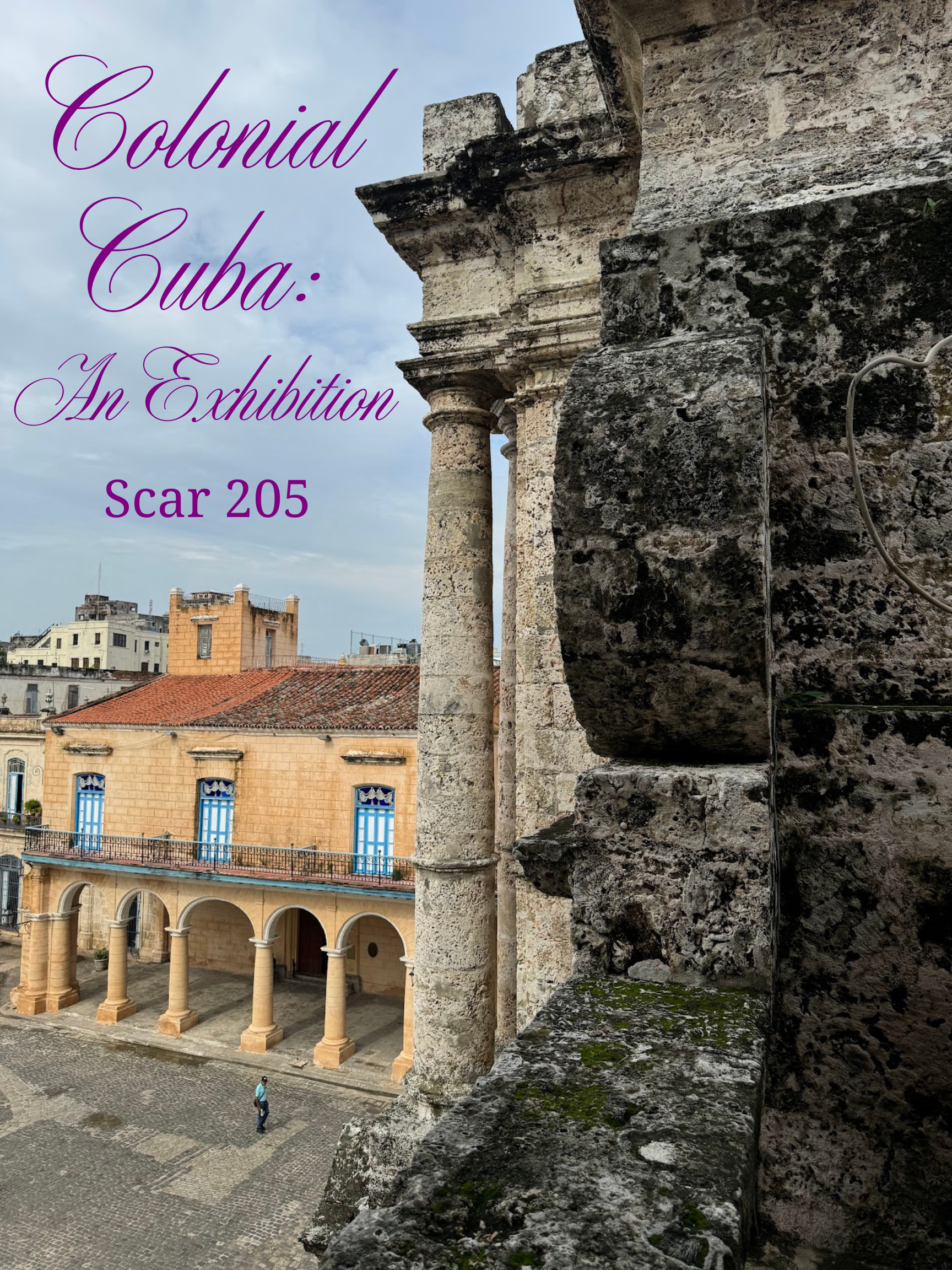
“Colonial Cuba: An Exhibition” is a project of the Spanish and Classics Programs at Rockford University, organized by the 2024 Study Abroad in Cuba and the students of the Colonial Latin America History class, taught by Dr. Yoandy Cabrera in Fall 2024.
Place: Hispanic and Cultural Lounge (Scar 205)
Date: December 5, 2024 – January 31, 2025
Havana City
1. La Muralla (City Wall)
Name of the monument: Havana City Wall
Location (city and country): Havana City, Cuba
The architect, governor, or artist’s name: Construction began during Francisco Rodríguez de Ledesma’s tenure in Cuba.
The year it was created: The idea of a wall existed since 1558. Its construction began in 1674 and extended for more than 100 years, until 1797, when the section facing Havana Bay was completed.
Brief description of the monument or building, its use, and significance: The stone wall surrounded Havana and stretched for nearly 5 kilometers (4,892 meters), with an average width of 1.40 meters and a regular height of 10 meters.
It was an extremely costly and militarily useless structure, leading to its eventual demolition in 1863, a little over a century after its completion.
As early as 1603, plans were made to build a wall to prevent enemy access by land. This landward side included the exposed coastline, particularly the forest that lay between the sea and the city in the area that would later become El Vedado.
The demolition began in 1863 with the tearing down of the Great Wall at the Monserrate Gates and was fully completed in the early 20th century.


2. José Martí’s Birthplace
Name of the monument: José Martí’s Birthplace
Location (city and country): Havana City, Cuba. Paula Street
The architect, governor, or artist’s name: Unknown
The year it was created: c. 1810
Brief description of the monument or building, its use, and significance: José Martí, Cuban national hero, was born in this modest house in 1853. This two-floor house was converted into a museum in 1925 and declared a National Monument in 1949. Its interior houses the largest collection of objects belonging to José Martí that are still being conserved today.
It was built at the beginning of the 19th century, rather close to the city walls, and has typical features of many houses in the area: a tiled roof and mortar walls.

RU students visiting the Cuban Art Museum in Old Havana in June 2024
3. Alameda de Paula (Promenade)
Name of the monument: Alameda de Paula (promenade)
Location (city and country): Havana City, Cuba
The architect, governor, or artist’s name: Arquitecto coronel de ingenieros Antonio Fernández de Trebejos y Zaldívar. Antonio Fernández de Trebejos had served as a soldier in the defense of Havana during the English invasion. Captain General Felipe de Fondesviela, Marqués de la Torre, came from the enlightened court of Charles III.
The year it was created: Built in 1777.
Brief description of the monument or building, its use, and significance: The first seaside promenade of the Cuban capital was named Paula, due to its proximity to the church of the same name. This first intramural promenade was established on the site of the old Rincón garbage dump, near Havana Bay. It also served as a social hub, much like a modern-day Tinder, where people gathered to meet and connect.

4. Plaza Vieja (Old Square)
Name of the monument: Plaza Vieja (Old Square)
Location (city and country): Havana City, Cuba
The architect, governor, or artist’s name: Enrique Capablanca
The year it was created: 1559
Brief description of the monument or building, its use, and significance: The Plaza Vieja, so named after the creation of Plaza del Cristo, which became the “new” plaza, was established as a public space for the town once the original plaza was designated for military activities. Its basic form emerged in the late 17th century and throughout the 18th century with the construction of arcades around its perimeter. Unlike other plazas, no church or administrative building is located there. The surrounding architecture is civil in nature and exemplifies the evolution of residential structures, featuring ground-floor arcades and an upper-level loggia serving as a viewing gallery.

5. San Francisco de Asís (Church)
Name of the monument: San Francisco de Asís
Location (city and country): Havana City, Cuba
The architect, governor, or artist’s name: Erected by Fray Juan Romero, its tower—the tallest of its time—was the work of architect José Arcés.
The year it was created: 1575-1738
Brief description of the monument or building, its use, and significance: The building represented the distinctive presence of the Franciscan Order in the Americas, whose mission was the evangelization of the population. The original structure was demolished in 1719 to make way for the construction of the current building, completed in 1738.
The old Cathedral of Havana once stood where the Palace of the Captains General (or Palace of the Governors) is now located. When it was decided to demolish that church and relocate the Cathedral, the Church of San Francisco de Asís, due to its size and beauty, was chosen for this honor.
Before the relocation could take place, Havana was attacked and occupied by the British. During the eleven months of British rule, two significant events affected the Church of San Francisco de Asís.
First, the Bishop of Havana, who had strained relations with the British, was imprisoned. Second, the British used the church for their religious practices.
After the British left Cuba, the Bishop of Havana declared the Church of San Francisco de Asís desecrated, rendering it unfit to serve as a Catholic place of worship. Eventually, the Cathedral was relocated to the small Jesuit church with a convent resembling a fortress, where it remains to this day.
The current Church of San Francisco de Asís was repurposed for various uses, including serving as the customs house for the port for many years, but it never returned to being a church.

6. Casa de la Obra Pía (House)
Name of the monument: Casa de la Obra Pía
Location (city and country): Havana City, Cuba
The architect, governor, or artist’s name: Daniel Taboada (restoration)
The year it was created: c. 1665
Brief description of the monument or building, its use, and significance: The name by which this house, Obra Pía, is known—and which also lends its name to the street providing access to its main façade—stems from the establishment in 1669 of a pious foundation by Martín Calvo de la Puerta. The foundation’s purpose was to provide annual financial support to five young orphaned women, enabling them to start families.
By 1793, some elements and forms of the so-called “Cuban Baroque” style were incorporated into the house. The portal, presumably designed and crafted in Cádiz around 1686, contrasts sharply with the stark and austere monumental façade on Obrapía Street, making it one of the most significant examples of Havana’s domestic architecture.

7. Palacio de los Capitanes Generales (Administrative Building)
Name of the monument: Palacio de los Capitanes Generales
Location (city and country): Havana City, Cuba
The architect, governor, or artist’s name: Its construction is attributed to the Havana military engineer Antonio Fernández Trevejos.
The year it was created: Its construction began in 1776.
Brief description of the monument or building, its use, and significance: This building is considered the most important architectural work of the entire Baroque period in Cuba. The palace was constructed near the old Cathedral of Havana, with construction beginning in 1776. It served as the residence of 65 Captain Generals sent by Spain to govern Cuba, as well as the headquarters of the U.S. Administrator during the intervention from 1898 to 1902. Additionally, during the Republic, it functioned as the Presidential Palace until 1920.
In its interior courtyard stands a statue of Christopher Columbus, placed there in 1862. The building also housed the town council, a jail, and several government offices.
The site where the palace now stands was home to a small Catholic church made of tiles and stone in 1574. Some historians believe this church was the one burned down by the pirate Jacques de Sores in 1555.
On the ruins of the old parish church, construction of the Government House began, completed in 1792 under the administration of Don Luis de las Casas. It became the official residence of Cuba’s colonial governors.

8. Castillo de la Real Fuerza (Fortress)
Name of the monument: Castillo de la Real Fuerza
Location (city and country): Havana City, Cuba
The architect, governor, or artist’s name: Under the direction of engineer Bartolomé Sánchez.
The year it was created: 1558-1577
Brief description of the monument or building, its use, and significance: After the destruction of the Fuerza Vieja, the first fortress of Havana, the construction of the Castillo de la Real Fuerza began on December 1, 1558. The fortress was built on the site that once held the original town square, facing the entrance canal to the Bay of Havana.
In 1762, during the British capture of Havana, despite its location deep within the entrance channel to the bay—diminishing its defensive effectiveness—the fort resisted British artillery positioned at La Cabaña. It served as one of the main centers for organizing the city’s defense, alongside the Castillo del Morro, becoming one of the key strongholds during the conflict.
In addition to housing the captains general and governors of Cuba, the Castillo de la Real Fuerza was used to store gold, silver, and other valuable goods in transit to Spain. After 1762, when the metropolis regained control of the city, the castle served as barracks for the troops stationed there. During the Ten Years’ War (1868-1878), it became the headquarters of the Havana Volunteer Corps.


9. Palacio del Segundo Cabo (Administrative Building)
Name of the monument: Palacio del Segundo Cabo
Location (city and country): Havana City, Cuba
The architect, governor, or artist’s name: It was directed by the Spanish architect Don Antonio Fernández de Trebejos y Zaldívar, a colonel of engineers in the Spanish Army, who also designed the plans for the construction of the Palace of the Captains General.
The year it was created: Its construction began in 1772 and took a long time to complete, finishing around 1791.
Brief description of the monument or building, its use, and significance: It was also known as the Palacio de la Intendencia and the Real Casa de Correos.
Simultaneously used as the Post Office and for other purposes such as the Intendance, Accounting, and General Treasury of the Army, the building became the residence of the Subinspector General Segundo Cabo, who served as vice-captain general. After all, it was the second-best building in the city, and he was the second-in-command of the island. He ordered the Post Office to be moved to the Casa del Marqués de Arcos in the Plaza de la Catedral. Since 1853, the building has been known as the Palacio del Segundo Cabo.
Initially, the palace was occupied by the Intendant of the Royal Treasury, and at the end of 1853, the second cabo of the colony took residence there. In 1902, with the establishment of the Republic of Cuba, the building housed the Senate until 1929, when the Capitolio Nacional was completed, and the National Congress was moved there.

10. El Templete (Monument)
Name of the monument: El Templete
Location (city and country): Havana City, Cuba
The architect, governor, or artist’s name: Colonel Don Antonio María de la Torre y Cárdenas, under the auspices of Captain General and Governor Francisco Dionisio Vives and the Bishop of Havana Juan José Díaz de Espada y Fernández de Landa.
The year it was created: 1828
Brief description of the monument or building, its use, and significance: A small Greco-Roman temple was erected in 1828. The first Mass in Havana was celebrated beneath a ceiba tree, similar to the one that stands in front of the building today. The interior was decorated with three murals by the French painter Jean Baptiste Vermay, who was the founder of the San Alejandro School.
Inside, three large canvases painted by Vermay were placed. These depicted the first Mass, the first town council, and a central painting—created later—showing the blessing of the site and the Mass officiated by Bishop Espada, with the Captain General, aristocracy, and high-ranking colonial officials in attendance.
In 1754, in memory of that first Mass, the governor of the island, Francisco Cagigal, erected a commemorative column. The column had three faces, symbolizing the territorial division of the colony into three provinces. At the top, an image of the Virgin of the Pillar was displayed. Two inscriptions were engraved on it, one in Latin and the other in old Spanish.
With the ceiba tree, its classical structure, and the first Mass of the city, this monument space has become a symbol of some of the most important traditions of the island: Greco-Roman, Christian, and Afro-Cuban.

11. Catedral de La Habana
Name of the monument: Catedral de La Habana
Location (city and country): Havana City, Cuba
The architect, governor, or artist’s name: Unknown
The year it was created: 1748 -1777
Brief description of the monument or building, its use, and significance: Initially, in 1748, the church was to serve as the oratory for the Sons of St. Ignatius of the Jesuit Order, and later it would become a cathedral. By Royal Decree on December 19, 1721, the Jesuits obtained the long-awaited permission, and on April 5, 1727, they were notified of the exact location where they could build the church and convent.
By 1767, the school was completed, but the church was not. At this time, the Jesuits were expelled from the New World. In 1772, due to the deplorable condition of the Parroquial Mayor (the main parish church), the Spanish authorities decided to relocate it to the Oratorio San Felipe Neri. On December 9, 1777, the church was moved to the partially built Jesuit church.
In 1778, by order of Bishop Felipe José de Tres Palacios, the transformation process began to convert the former Oratorio de San Ignacio into the Havana Cathedral, dedicated to the Immaculate Conception, with its image visible on the Main Altar. During the episcopate of Bishop Juan José Díaz de Espada y Fernández de Landa, significant reforms were carried out.

12. Seminario de San Carlos y San Ambrisio (Seminary)
Name of the monument: Seminario de San Carlos y San Ambrosio
Location (city and country): Havana City, Cuba
The architect, governor, or artist’s name: Unknown
The year it was created: c. 1774
Brief description of the monument or building, its use, and significance: On October 3, 1774, the Real Colegio Seminario San Carlos y San Ambrosio opened its doors to students, featuring its innovative, undulating Baroque-style façade. Its first rector was the Cuban priest Doctor Rafael Castillo y Sucre. The students enrolled were a mix of those pursuing ecclesiastical studies and others who would follow civil careers.
In 1817, under the guidance of Bishop Espada, the seminary gained new vitality. With the help of Father Félix Varela, a Chemistry and Physics laboratory was established for the first time in Cuba, along with a Chair of Constitution. At the same time, teaching in the vernacular language was introduced. The institution eventually had 700 students.
“At precisely that point someone came to open the heavy cedar panels of the door of the seminary, better known in those days as the Colegio de San Carlos. The main courtyard consisted of four wide walkways, flanked by stone columns forming a square. In the middle was a fountain, and all round it luxurious and leafy orange trees. On the side opposite the main entrance, to the left, was a stone staircase that led to the studies of the professors; to the “right was a grille that separated the walkway from a dark, damp alley, which led to a filthy auditorium, longer than it was wide, off to one side, separated from the waters of the port by a garden or orchard with towering adobe walls. Overlooking it were four little windows set high up in the wall, through which the only light entered. Leaning against the front wall, in the middle of it, was a highbacked, badly made professor’s chair, and on either side of it many “wooden benches, rough-hewn but sturdy, placed transversely.”
Cirilo Villaverde, Cecilia Valdés


Camagüey
13. Iglesia de Nuestra Señora de la Merced (Church)
Name of the monument: Church of Nuestra Señora de la Merced
Location (city and country): Camagüey City
The architect, governor, or artist’s name: Unknown
The year it was created: 1601, 1748
Brief description of the monument or building, its use, and significance: The first temple dates back to 1601, but it was destroyed and replaced by the one built in 1748. Its tower is one of the most solid and beautiful on the island. The crypts house a small museum.
Its history is imbued with legend. Local myth tells of a miraculous figure that floated from the watery depths here in 1601, and it has been a spot of worship ever since. The active convent in the attached cloister is distinguished by its two-level arched interior, spooky catacombs (where the church faithful were buried until 1814), and the dazzling Santo Sepulcro, a solid silver coffin.

14. Plaza e Iglesia del Carmen (Square and Church)
Name of the monument: Iglesia del Carmen Square and Church
Location (city and country): Camagüey City
The architect, governor, or artist’s name: Unknown
The year it was created: 1825
Brief description of the monument or building, its use, and significance: The Iglesia del Carmen, located in the square of the same name, is the only church in Camagüey with two towers and was the fourth to be built with these features in Cuba. Although its majestic façade with three entrances suggests a building with three naves, it actually has a single-nave layout of modest proportions, including a vestibule, choir, presbytery, and sacristy. Its construction dates back to the years 1823-1825.

15. Iglesia y Hospital de San Juan de Dios (Church and Hospital)
Name of the monument: San Juan de Dios Church and Hospital
Location (city and country): Camagüey City
The architect, governor, or artist’s name: Unknown
The year it was created: 1736
Brief description of the monument or building, its use, and significance: The construction of the current temple began in 1736 and was completed in 1755. By this time, the Bishop had officially established the Hospitaller Order of St. John of God.
On May 11, 1873, the body of Ignacio Agramonte y Loynaz, Major General of the Cuban Liberation Army, was displayed in one of the hospital corridors for recognition and identification.
In 1952, the building became the San Juan de Dios Children’s Hospital until 1969. Currently, it is a museum with exhibition spaces that showcase the history of the building through its different historical periods.

Los últimos destellos del atardecer envuelven las fachadas de la Plaza de San Juan de Dios iluminando a medias el quehacer de los vecinos. Una señora limpia arroz sentada en un quicio; a su lado, una muchacha cuelga unas ropas húmedas de bebé sobre los balaustres semipodridos del ventanal de madera. Tres casas más allá, dos hombres en camiseta beben ron. En la esquina, cuatro muchachos patean un balón desinflado contra las paredes del antiguo hospital.
[The last glimmers of sunset bathe the facades of San Juan de Dios Square, casting a half-light over the activities of the neighbors. A woman sits on a doorstep cleaning rice; beside her, a young woman hangs damp baby clothes on the rotting balusters of a wooden window frame. Three houses down, two men in undershirts drink rum. On the corner, four boys kick a deflated ball against the walls of the old hospital.]
Dashel Hernández, Herbario: 1984-1986
Oganizers:
Dr. Yoandy Cabrera
Karina Campos (Spanish Major, Foreign Language Assistant)
Students Who Collaborated in the Project:
Karol Vega Hernandez
Andrew Johnson
Derrick Hozey
Ivan Ramos
Silia Banza
Maddyson Halpin
Jacob Harker
Nicholas Rich
Hae Htoo
Annelise Loser
Meeghan Archer
Nashaly Rangel
(Students from the Colonial Latin American History class, Fall 2024)


 Deinós
Leave a comment