
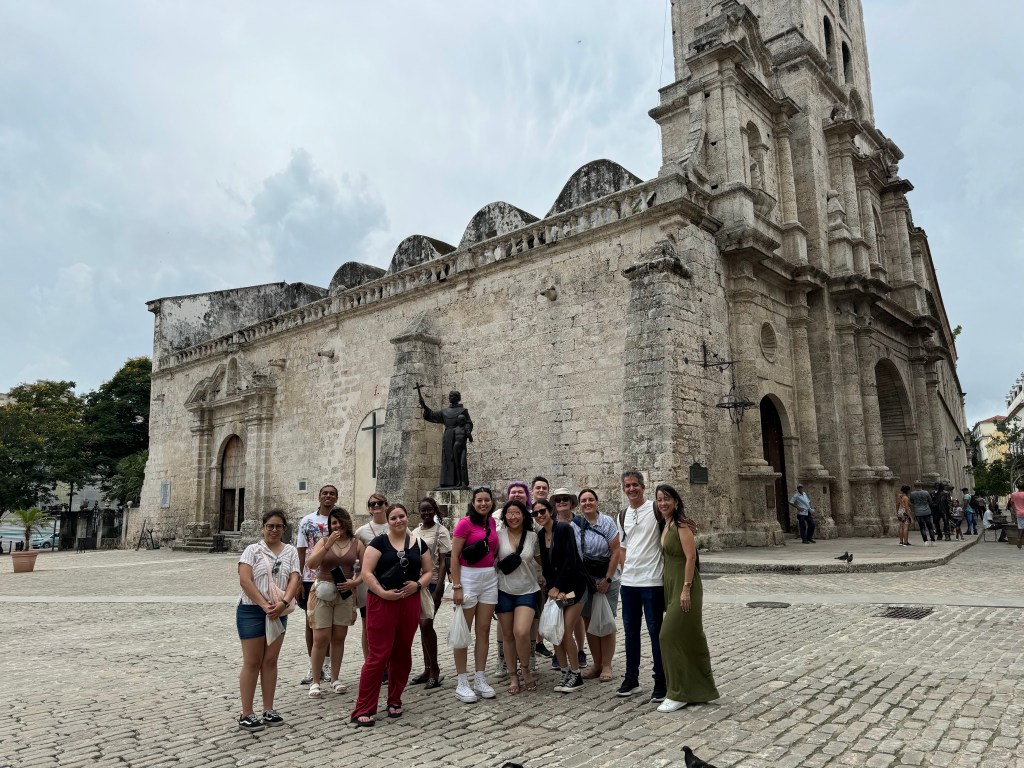

Our Spanish and Classics programs took a group of students to Cuba in June 2024 to visit various colonial monuments, sites, and museums in Havana, Camagüey, and Matanzas.

This study abroad program is connected to the Colonial Latin American History class and the Classical Reception courses taught by Dr. Yoandy Cabrera at Rockford University.

Our students presented in situ about colonial churches, official buildings, fortresses, squares, cathedrals, houses, convents, and academic buildings such as El Palacio de los Capitanes Generales, La Catedral de La Habana, El Templete, Iglesia de la Merced, El Castillo de la Real Fuerza, Alameda de Paula, La Casa de la Obra Pía, and El Seminario de San Carlos y San Ambrosio, among many others.


We also had the opportunity to visit the National Museum of Fine Arts. During our visit, Laura Arañó Arencibia, Head of the Department of Collections and Curatorial Affairs, explained some of the main Cuban artworks to our students.


On Saturday, June 22nd, we attended Réquiem por Yarini, a play by Carlos Felipe presented by Teatro El Público, one of the most important Cuban theater companies. Carlos Díaz, the company’s director, and Norge Espinosa, the dramaturg, took a moment to welcome our students and professors.


During our visits to Old Havana and Camagüey, our group was accompanied by Dr. Leonardo Sarría, a professor at the University of Havana and a scholar of colonial culture. As we explored the various sites, he introduced us to Cuban colonial art, literature, and society.

Dr. Leonardo Sarría (University of Havana):
My thanks to Rockford University for the opportunity to have shared with students and professors an experience of mutual growth in Havana, Camaguey, and Matanzas last June. It was a pleasure to be able to accompany them in their study program for colonial culture, to which I’ve already dedicated various years of work. In front of each one of the buildings, squares, and monuments of the old colonial Cuba, the students presented the result of their previous research and exchanged with myself and other specialists on other issues and topics within their interest. This academic exercise, which I will incorporate in my own classes in Havana, formed part of the itinerary exemplarily designed by Dr. Yoandy Cabrera, who was once again an excellent and amicable colleague.

In Camagüey, Dr. María Antonia Borroto, a professor and journalist responsible for the website https://www.elcamaguey.org/, took us to visit churches, catacombs, squares, colonial hospitals, convents, and many other sites. Listening to María Antonia talk about her city is an experience our students will never forget. We especially enjoyed La Iglesia de Nuestra Señora de La Merced and San Juan de Dios Square and Hospital.

Dr. María Antonia Borroto (Higher Institute of Art, Camagüey):
Interacting with the students and professors of Rockford University was a very gratifying experience, and I would even say rejuvenating. The exchange with young men and women always is rejuvenating, mainly if one perceives their curiosity and penchant for learning. I was also able to appreciate their respect and cordiality, exceptionally good energy, and friendly ambiance that made the whole experience very easygoing. An exchange of this nature is a challenge, a joyful challenge, in which we all learn. Some questions they asked me, even when at first glance they could seem ingenuous, left me meditating precisely on the questions related to the identity of this region that is so peculiar. And that is good, very good. Therefore, it was especially encouraging to note that the website El Camagüey (elcamaguey.org), a space that I coordinate, contributed to their previous knowledge. The doors of Camaguey and elcamaguey.org will stay open for projects of this nature. Thank you for letting me be part of it.

During this trip, our students not only had the opportunity to learn more about colonial Latin American culture but also gained firsthand experience of the many challenges the Cuban people are facing today.

In addition, after many academic presentations and visits to monuments and sites, we found time to relax on the beach the day before our return.

Some testimonies from students and professors:
If I could describe my study abroad trip to Cuba in one word it would be eye- opening . The moments I witnessed made me change my perspective on the way I view and treat life. Going into the trip I did not expect to see such beautiful architecture, watch Réquiem por Yarini, an amazing play that gave me goosebumps, and be touched by the stories of residents in the area. Looking back at the trip I am now thankful for what I have, grateful for the education I can receive, and gratified to be able to live free. Lastly, Thank you to Dr. Cabrera and Rockford University for the amazing opportunity, If I could relive this experience again I would.
(Denise Hernandez-Ortega, RU Student, Education Pathway)

I am extremely grateful to have obtained SOF funding. Because of this opportunity, I was able to participate in the Cuba Study Abroad 2024. I achieved a very beautiful and humbling experience in different environments and communities. Not only was I able to build amazing relationships with Cuban residents, but I also had the opportunity to learn and visually see the colonial period. I truly felt that my history knowledge has been fully achieved the moment I received the opportunity to see and experience many colonial cultures in person. This program helped me gain experience in the area of diverse cultures and mindsets. I gained the knowledge that we humans have very diverse lives yet in one way or another we can still relate to each other and connect life events even when we live across the world. I was also allowed to use my future teaching and interpretation skills by being flexible in learning, listening, and translating information between two different languages at the same time. I loved this trip because not only did I learn, practice, and gain skills, but I also helped those who surrounded me in any circumstance. I have personally always loved to help others in any way I can, therefore to have the opportunity to share my knowledge and help others was very special to me. I was also given the opportunity to practice my leadership skills by organizing and assisting Dr. Cabrera in anything that he needed extra help with. I arrived in Cuba with three amazing friends and I came back with twenty new beautiful friendships, all because of this program.
During my time in Cuba, I had the opportunity to attend a theater play; Réquiem por Yarini. This piece of art was beautiful. Actors genuinely expressed each emotion and their talent was immaculate. I truly believe that the director and author of this play did an amazing job in retelling Yarini’s life in a method that anyone could understand with modern language. Not only was this play well written and represented, but this story visually allowed us to experience the life of Yarini as if we were part of the story as well. It truly felt like I was in the 19-20th centuries living during Yarini’s life.
(Karina Campos, RU Student, Spanish Major)

One of the most remarkable experiences during our trip was the opportunity for our group to visit the Art Museum in Havana. We were particularly fortunate our trip coincided with an exhibition featuring the renowned Cuban artist Manuel Mendive. It was a privilege to witness artworks that might otherwise remain inaccessible to us. Mendive’s display encapsulated his entire career, including pieces created during his very early years, making it a truly exceptional visit. Since my return, discussions within my family have often centered on his works addressing the theme of slavery, particularly his poignant piece, “Barco Negrero.”
Additionally, I was deeply moved by other artists, including a painting by Carlos Enríquez titled “Retrato de María Luisa Gómez Mena.” Our curator and guide provided us with a wealth of historical context, enriching our understanding of the artworks we encountered. It felt like an exclusive tour of Cuba’s most esteemed artists, and I felt a profound sense of pride in having experienced such a culturally significant event.
We genuinely came to understand the profound implications of living without freedom. Throughout our trip, there were numerous instances where we felt the weight of surveillance upon us. Open and candid discourse felt constrained; even when local citizens sought to discuss their grievances, we were compelled to distance ourselves to avoid inadvertently participating in conversations that could be perceived as critical of the government. I truly felt an appreciation for the safety of freedom we have in the United States.
I was profoundly moved by the stark realities of poverty we encountered. While I have traveled to various countries and witnessed poverty, including in the United States, the experience in Cuba was distinctly different. My heart ached for the individuals enduring such challenging conditions; many homes appeared shrouded in darkness, and numerous buildings were in a state of disrepair. It reminded me of New Orleans after Katrina. The buildings so damaged and beauty is just underneath.
Despite these hardships, the warmth and kindness of the people we met were remarkable. One young woman, who operated a roadside restaurant behind her home, exemplified this spirit. She prepared a delicious meal for us and took the time to explain her cooking methods, even showing us a particular Cuban pepper to explain her recipe . Her cooking and generosity were truly exceptional.
Furthermore, our guide Leo and his wife Sandra were among the highlights of our time in Cuba. I gained invaluable insights from Leo regarding the country and its architecture. Although Sandra, a Colombian, did not speak English, her kindness transcended any language barrier. We were incredibly fortunate that Dr. Cabrera Ortega facilitated this once-in-a-lifetime opportunity, and I feel profoundly blessed for the experience.
(Antonia Rowe, Director of Advising and Administration, Adjunct Professor, Puri School of Business, RU)

What I learned from the trip to Cuba was the resilience of the Cuban people. They face several hardships in everyday life such as limited electricity, water, supplies, etc., but they have learned to work within these limitations. The city of Havana is beautiful, especially in the tourist areas. It has a blend of old and newer architecture. The colonial buildings, the antique automobiles, the multiethnic culture, etc. all add to the charm of this country. I have always wanted to visit Cuba, and I am very glad I had this opportunity.
(Dr. Donna Ogle, Assistant Professor of Computer Science)




 Deinós
Leave a comment